



























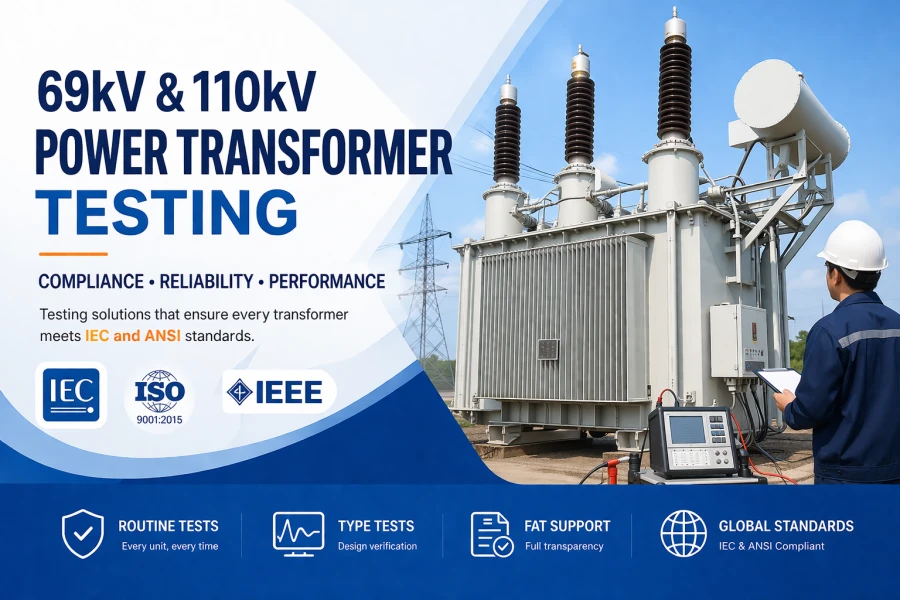
Introducción
For utilities, EPC contractors, and industrial power users, transformer reliability is critical to ensuring stable grid operation and long-term performance. Testing is not just a procedural step—it is a mandatory requirement for compliance, safety, and project acceptance.
In this guide, we provide a comprehensive overview of testing procedures for 69kV and 110kV power transformers, covering IEC and ANSI standards, key test categories, and factory acceptance practices.
Types of Transformer Tests
Transformer testing is generally divided into three main categories:
1. Routine Tests (Mandatory for Every Unit)
Routine tests are performed on every transformer before delivery to ensure it meets specified requirements.
Key routine tests include:
- Medición de la resistencia del bobinado
- Turns ratio and vector group verification
- Insulation resistance test
- No-load loss and current test
- Short-circuit impedance and load loss test
These tests confirm the electrical integrity and performance consistency of each unit.
2. Type Tests (Design Validation)
Type tests are conducted on representative units to validate the transformer design.
Typical type tests include:
- Prueba de aumento de temperatura
- Prueba de impulso de rayo
Para 110kV transformers, impulse testing is especially critical due to higher insulation requirements.
3. Special Tests (Project-Specific Requirements)
Special tests are carried out based on client specifications or project conditions.
Examples include:
- Partial discharge measurement
- Noise level test
- Zero-sequence impedance test
- Capacitance and tan delta test
These tests are often required for utility-scale or sensitive industrial applications.
Key Differences Between 69kV and 110kV Transformer Testing
While testing procedures are broadly similar, there are important differences between 69kV and 110kV transformers:
- Insulation Levels: 110kV transformers require higher insulation strength
- Test Voltage: Higher voltage levels demand stricter dielectric testing
- Impulse Testing: More stringent for 110kV units
- Application Scope: 110kV is typically used in transmission or sub-transmission systems
Understanding these differences is essential when specifying or evaluating transformer performance.
Get More:Power Transformer Manufacturer at the 139th Canton Fair Energy Transformer Global Supplier
IEC vs ANSI Transformer Testing Standards
Transformer testing requirements vary depending on regional standards:
IEC Standards
- Standard: IEC 60076
- Widely used in Europe, Asia, Africa, and international projects
- Emphasis on global compatibility
ANSI/IEEE Standards
- Standard: IEEE C57 series
- Common in North America (USA, Canada)
- Includes specific requirements for utility applications
For global projects, manufacturers must be capable of complying with both IEC and ANSI standards.
Factory Acceptance Testing (FAT)
Factory Acceptance Testing (FAT) is a critical stage where customers verify transformer performance before shipment.
A typical FAT process includes:
- Witnessing routine and selected type tests
- Reviewing test procedures and results
- Verifying compliance with specifications
- Issuance of official test reports
Many manufacturers now offer:
- On-site customer inspection
- Third-party certification (SGS, BV, etc.)
- Video-based FAT for remote clients
FAT ensures transparency and builds confidence before delivery.
Read More:Power Transformer Solutions for Ecuador ANSI-Compliant Manufacturer – Energy Transformer
What Does a Transformer Test Report Include?
A complete transformer test report typically contains:
- Test data and measurement results
- Calibration certificates
- Test curves and graphs
- Compliance statements (IEC / ANSI)
- Nameplate and technical specifications
A well-documented test report is essential for project approval and long-term asset management.
How We Ensure Reliable Transformer Testing
As a professional power transformer manufacturer, we ensure high-quality testing through:
- Full compliance with IEC 60076 and IEEE C57 standards
- Advanced high-voltage testing laboratory
- Experienced engineering and QA teams
- Strict quality control procedures for every unit
We support:
- 69kV and 110kV power transformers
- Customized testing protocols based on project requirements
- Global project delivery across North America, South America, Africa, and Asia
Conclusión
Testing is a critical part of transformer manufacturing, ensuring safety, reliability, and compliance with international standards. Whether for 69kV or 110kV systems, a robust testing process guarantees long-term performance and project success.
📞 Get in Touch
Looking for a reliable supplier of 69 kV or 110kV power transformers?
Contact us today for:
- Asesoramiento técnico
- Competitive quotations
- Detailed test reports and documentation
We are ready to support your next power infrastructure project.