



























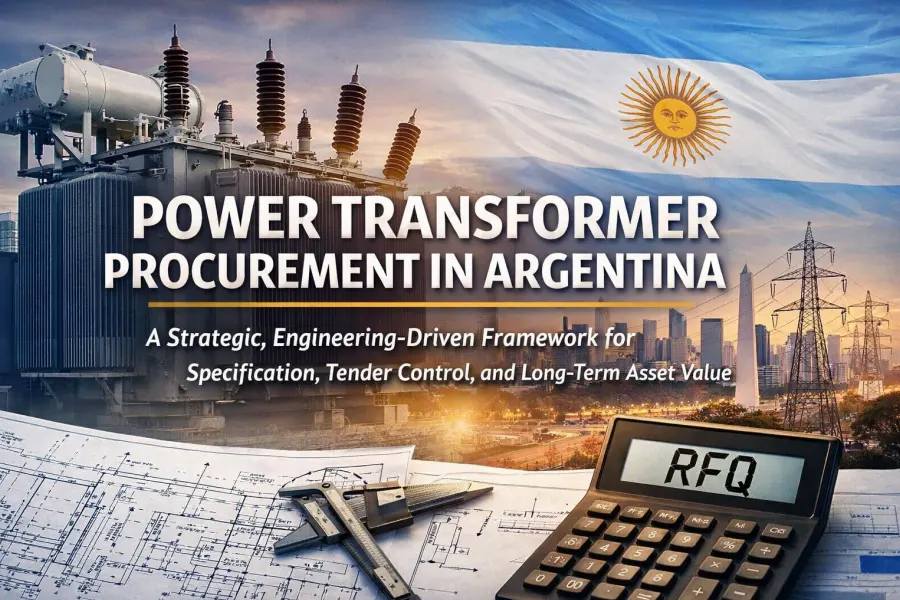
A Strategic, Engineering-Driven Framework for Specification, Tender Control, and Long-Term Asset Value
Power transformer procurement in Argentina sits at the intersection of engineering reliability, regulatory compliance, and long-term financial exposure.
Unlike many electrical components, a transformer is not easily replaced, upgraded, or standardized once installed. Every procurement decision therefore embeds 20–30 years of technical and economic consequences.
This article is written as a decision framework, not a supplier overview. It is designed for:
-
Utility procurement teams
-
EPC technical managers
-
Industrial power system owners
who must justify decisions internally and control project risk externally.
1. Transformer Procurement Is an Asset-Management Decision, Not a Purchase
In mature power markets, transformers are treated as capital assets, not equipment.
Yet in Argentina, procurement often fails because:
-
CAPEX pressure overrides lifecycle analysis
-
Technical specifications are copied from legacy projects
-
Supplier evaluation focuses on unit price, not risk exposure
Key insight:
A transformer selected purely on price transfers risk from the supplier to the asset owner.
2. The Hidden Engineering Variables That Define Long-Term Performance
2.1 Loading Philosophy (The Most Misunderstood Variable)
Many RFQs specify only rated power (MVA), without defining loading profile.
In reality, transformer aging is governed by:
-
Hot-spot temperature
-
Load duration
-
Cooling reserve
Best-practice loading model:
-
Normal operation: 65–80% rated load
-
Emergency overload: defined, time-limited
-
Continuous operation above 90%: avoided
Failing to define this leads to premature insulation degradation.
2.2 Voltage, Taps, and Grid Interaction
Argentina’s grid is not uniform. Voltage fluctuation and reactive power flow vary by region.
Procurement teams should define:
-
Tap changer type (off-load / on-load)
-
Tap range and step resolution
-
Voltage regulation philosophy
A transformer that cannot regulate voltage properly will:
-
Increase system losses
-
Trigger protection miscoordination
-
Reduce grid acceptance margins
2.3 Losses as a Financial Variable (Not a Technical Footnote)
Losses must be evaluated as cash flow, not watts.
Lifecycle loss cost depends on:
-
Energy tariff assumptions
-
Load growth forecast
-
Discount rate
In many Argentine industrial projects, loss capitalization exceeds transformer CAPEX within 10–15 years.
Advanced buyers now request:
-
Guaranteed loss values
-
Loss penalty clauses
-
Comparative loss evaluation in bid scoring
Read More:How to Choose the Right Power Transformer Manufacturer in Argentina
3. RFQ Design as a Risk-Control Instrument
A well-structured RFQ reduces procurement uncertainty more effectively than supplier reputation alone.
3.1 Mandatory RFQ Sections for Argentina
A robust RFQ should include:
-
Electrical design parameters
-
Environmental & seismic data
-
Performance guarantees
-
Testing and acceptance criteria
-
Documentation and drawing control
-
Logistics responsibility definition
Weak RFQs create strong disputes later.
3.2 Testing Strategy: Where Most Buyers Lose Leverage
Testing is not about compliance—it is about risk ownership.
Procurement teams should explicitly define:
-
Which tests are routine vs type
-
FAT witness rights
-
Acceptance thresholds
-
Handling of non-conformities
If testing scope is vague, acceptance becomes subjective.
4. Local vs Imported Transformers: A Strategic Comparison
The decision is not binary; it is project-specific.
4.1 When Local Supply Makes Sense
-
Small distribution units
-
Tight delivery windows
-
Limited technical customization
4.2 When Imported Supply Is Strategically Superior
-
Medium & high-voltage transformers
-
EPC-driven projects
-
Loss-optimized or compact designs
-
CAPEX-sensitive developments
Chinese manufacturers have shifted from cost competitors to engineering competitors over the past decade.
5. Energy Transformer as a Procurement-Oriented Manufacturer
Energy Transformer’s relevance in Argentina lies not in geography, but in process maturity.
5.1 Engineering-Centered Manufacturing Model
-
Project-based design review
-
Thermal and loss optimization
-
Custom voltage and tap solutions
5.2 Standardization Where It Matters
-
IEC / ANSI-aligned documentation
-
FAT-ready testing protocols
-
Export-compliant packaging
This reduces interface friction with EPCs and utilities.
5.3 Lifecycle Economics, Not Entry Price
Energy Transformer’s designs prioritize:
-
Lower no-load loss
-
Stable thermal behavior
-
Predictable aging performance
This aligns with long-term asset ownership, not short-term procurement cycles.
6. A Simple Decision Model for Procurement Leaders
Before awarding a transformer contract, decision-makers should answer:
-
Is loading philosophy explicitly defined?
-
Are losses financially evaluated, not just specified?
-
Is testing scope contractually enforceable?
-
Does the supplier control logistics risk?
-
Can the supplier support commissioning and early operation?
If any answer is “no,” procurement risk remains high.
Conclusion: Procurement Defines Reliability Long Before Energization
In Argentina, most transformer failures are designed, not manufactured.
They originate in:
-
Incomplete specifications
-
Weak RFQs
-
Price-driven evaluation models
Energy Transformer offers Argentine projects a globally competitive, engineering-driven alternative—one that aligns procurement decisions with long-term system reliability and financial performance.
Call to Action (High-Intent)
If you are preparing an RFQ or tender for a power, industrial, or renewable energy project in Argentina,
Energy Transformer can support you with:
-
Specification review & optimization
-
Loss and loading analysis
-
Factory-direct pricing with full technical transparency
👉 Submit your project requirements today and convert procurement risk into long-term asset value.